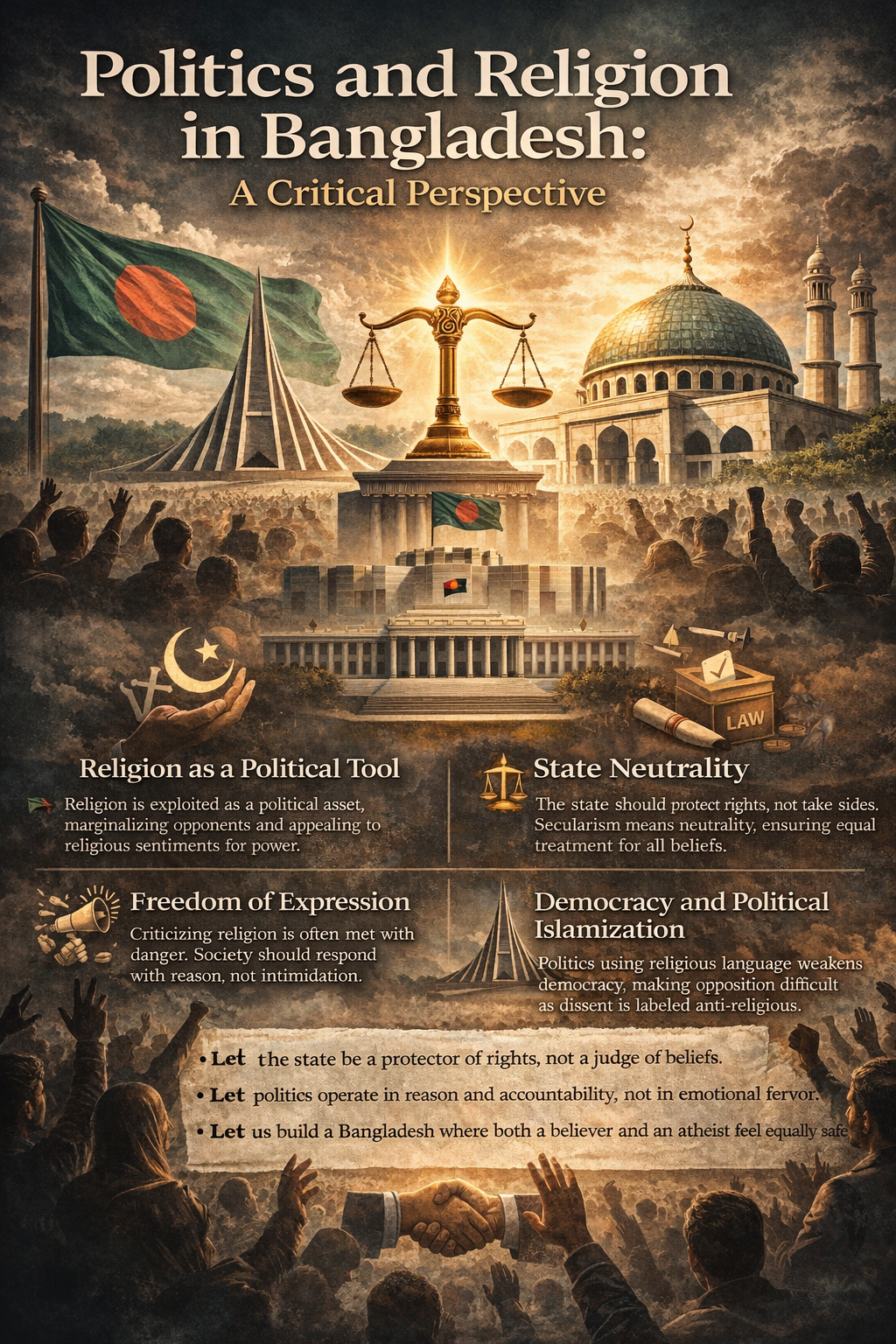

Apurbo Ahmed Jewel: The Constitution of Bangladesh speaks of secularism on one hand, yet on the other hand recognizes Islam as the state religion. From an atheist perspective, this contradiction is logically harmful and deeply problematic. Many rules and beliefs within Islam conflict with modern reality and are scientifically or morally questionable. If a state gives priority to one religion, it creates a threat to fundamental freedoms, equality, and rational thinking.
First, the foundations of Islam — the Qur’an and Hadith — are often viewed as containing claims that clash with modern scientific understanding and contemporary ethical standards. Issues concerning the Earth, human life, gender relations, and social justice are governed by rules that many argue are outdated and incompatible with present-day human rights principles. For example, provisions that reduce women’s rights, allow gender inequality, and impose severe punishments are framed as divine commands. If a religion limits women’s autonomy, it cannot genuinely represent equality or justice in a modern democratic state.
Second, the concept of punishment based on belief or disbelief poses a serious concern from a secular and atheist standpoint. Historically and in some interpretations, disbelief, apostasy, or criticism of religion have been treated as crimes deserving punishment. Such ideas undermine freedom of thought, critical analysis, and freedom of expression. If these religious principles influence state policy, citizens may lose the ability to make knowledge-based and rational decisions without fear.
Third, certain interpretations of Islamic legal and social codes conflict with internationally recognized human rights norms. Regulations regarding dress, personal behavior, family law, and religious courts often prioritize religious doctrine over individual autonomy. When religion shapes legal authority, it can result in discriminatory practices against women, religious minorities, and non-believers. From an atheist perspective, this demonstrates how religious dominance within the state can lead to structural inequality.
Fourth, discouraging or punishing criticism of religious texts or beliefs contradicts the principles of free inquiry and open debate. In various traditional interpretations, strong warnings and punishments are directed at non-believers and critics. This fosters a culture of fear rather than reasoned dialogue. A society that restricts questioning cannot nurture scientific progress or intellectual freedom. For atheists and free-thinkers, this environment represents a direct threat.
Fifth, practices such as polygamy, gender-based inheritance rules, and strict punitive laws are often defended through religious justification. Critics argue that these reinforce unequal power structures and obstruct social progress toward fairness and equality. When religion resists challenges from science, human rights discourse, and rational philosophy, it can become an obstacle to development.
In summary, granting Islam the status of state religion in Bangladesh creates a constitutional contradiction and symbolically elevates one belief system above all others. From an atheist standpoint, this threatens personal liberty, equality before the law, and rational thought. A genuinely secular framework would ensure that all religions, as well as atheism and diverse philosophies, are treated equally by the state. Exposing inconsistencies and advocating for secularism is, therefore, seen as a civic responsibility to prevent any individual from being subjected to oppressive or discriminatory policies in the name of religion.